
Volume 5, Entry 8: Rainwater
And the accumulation thereof

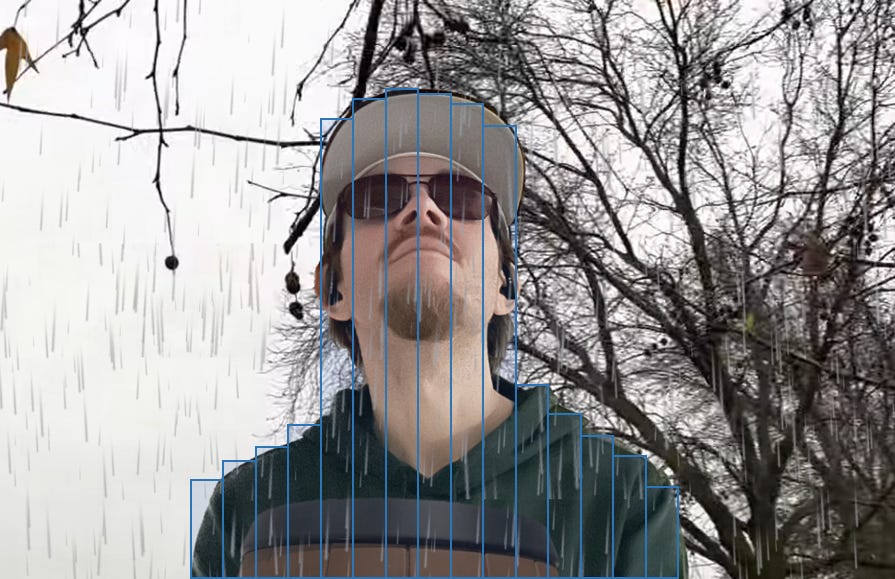
Among the phenomena I’ve summoned to explain integral calculus, few do the job better than rain.
Imagine you’ve got a barrel. I picture a wooden barrel myself with black painted collars and a red-and-yellow DK on it, but you can picture your version. It’s about to rain, and you place your barrel outside. Precipitation falls for hours, always in translucent little droplets so gentle that they sound only the softest patters against the roof. Not one of those raindrops possesses meaningful volume; you could round each one down to zero, and none but the pedants could quibble.
Still, given several hours or days of next-to-nothing rainfall, a mathematical miracle will occur inside your barrel. All those tiny morsels of moisture, each individually almost negligible, every one too small to realistically register, will have become a something: their accumulation leaves a volume of water. Maybe it even fills the barrel. One raindrop is basically nothing, yet given time, a whole lot of basically nothing adds up into a definitely something.
This is the liquid essence of Calculus. A definite integral sums up an infinite number of infinitesimally thin rectangles to form a region with a meaningful area. Each rectangle is too thin to have greater than negligible area, but when enough of them accumulate, the space under a curve fills like a barrel in the rain.
That geometric depiction captures the concept, but it isn’t comprehensive. Definite integrals calculate area, but we interpret that area as other meaningful quantities. Those tiny little rectangles stand in for minuscule changes. Each raindrop produces an insignificant change, increasing the water’s volume by nothing! But given many, many, many seconds, even that insignificant moisture can fill a barrel.
Students know rainfall, and they know barrels (or buckets), so there’s an intuition invoking it builds upon. I could use sand in a sandbox, each grain a speck of nothing, and some years I go with coin jars, but I regularly appeal to rainwater. I teach the lesson in January, after all. Rain remains relevant in January.
Mathematics aside, I used to loathe the rain. Waking up in February and March, I’d click on the weather forecast with dread. Heavy rain on a Thursday or Friday in February threatened baseball tryouts; in March, one rough storm could wipe out an entire week of practice.
So important was baseball to me that wet winters induced personal tailspins. When inclement weather encroached on coaching, I slouched and suffered. Most years, baseball brought my one social outlet; the diamond delivered interaction and camaraderie organically in a way nothing else did. There were practices to run, games to manage, and statistics to input, but also meetings to attend, teams to scout, and dinners to discuss decisions over. It was an entire world in and of itself, and it was the one world where I knew my place and thrived.
So long as it didn’t rain. Gray skies posed a threat; dark clouds loitered, waiting to sabotage my plans. Some years, I turned muck and misery into team parties under gazebos or dug trenches in torrential downpours to salvage season-openers, but mostly, I just resented the rain as it blew up the best part of being alive.
Unsurprisingly, I don’t feel animosity toward the rain anymore. I last coached in 2017, far enough back that every player on those teams has graduated from high school, and I haven’t coached a full season since 2012. Whereas rain once wrecked me—and even hastened the end of my high school coaching career—now I find it pleasant and peaceful. Sure, it can still spoil plans, rescheduling walks and disrupting drives, but the pattering of precipitation soothes me.
I walked to the grocery store yesterday morning under menacing clouds. Planning to make a chocolate satin pie but with mint Oreo crust, I decided to risk a little wetness by integrating a last-second supply run into my morning routine. A winding trail through the neighborhood eventually led me out and alongside Franklin Blvd, where I followed the final two blocks, looking directly at an impending storm.
And smiling.
All these thoughts about rainwater found me then. While clouds obscured the sky, they unveiled in me evidence of change. My grin at the prospect of precipitation provided proof of a massive shift. I could still remember the intense ache that wet weekends once induced; some sliver of voice still sounds that sadness siren automatically in my brain, echoing outdated iterations of me expired for over a decade. That diminished resentment had once sloshed around my head, ready to spill its contents onto everything, but now it was merely one droplet, one microbe of moisture. I paid it no mind. It barely left a ripple.
When I started thinking more broadly about change, the floodgates opened. Walking to a grocery store marked change, my fervent commitment to exercise a world away from the sedentary lifestyle I observed between baseball practices. My willingness to be visible, walking along the busiest road in my area all alone, demonstrated growth, as did my objective of securing supplies for a from-scratch pie—I was useless in the kitchen then. And, of course, in my ear sang Taylor Swift, the songs of folklore sweeping me away with every entry. I wouldn’t have been caught dead playing her music ten years ago; on this morning, I sang every song under my breath. I might have even teared up when I let one track engulf me.
Semi-sweet chocolate and mint Oreos in my hands, I walked home soon after, uncertain if I could beat the rain but unconcerned. My mind had too much to juggle between losing myself in “august” and accounting for growth. How pragmatically I regarded that song of unrequited love; how confidently I strode along the creek. How optimistically I looked forward to the evening that would follow.
That last one caught in my head like a catcher’s cleats in post-showers mud. My plans for the evening were simple, with some test revisions on tap before cooking a simple dinner, making whipped cream for the pie, and phoning a friend for our regular weekend chat.
As much as anything all day, those plans showcased a shift with its origins in baseball and rain. Although I last coached in 2017, my coaching career began in 2004, well before the first iPhones and even further from when smartphones became ubiquitous. When the weather washed away a practice or game then, I had to call every player’s family, one by one, on the phone.
And I hated the phone.
Throughout my life, I’ve had a rough relationship with phones. To this day, I still get shaky when unexpected calls arrive. Catastrophizing can’t be helped once you lose a role model to an innocuous ring while typing a box score for your all-star team. But that was only one contributor to what became a phobia of sorts: also contributing condensation were coaches raking me over the coals for player placements, drunk messages from players’ parents, and the litany of pissed-off people whose schedules I had to rattle when informing them about new itineraries. Some of those uncomfortable calls raised the waterline more than others, but all added to the accumulation of apprehension about answering a phone call.
While bobbing my head to “invisible string”, I pondered my move from avoiding calls at all costs to eagerly anticipating one as the highlight of my day. Was it my distance from the fateful ring that announced Dwight’s death in 2001? Was it sitting sixteen years from the cruelest caller? Was it putting twelve years between me and those agitated sighs of frustrated fathers and moody mothers whom I knew probably weren’t mad at me, but I could never convince myself weren’t? Was it just time slowly shaving off shreds of alarm per hour, decumulating distress until the worry wore off, a series of sub-x-axis rectangles?
I’m sure it was—and is. But also, I knew it wasn’t.
In 2015, a person sat across from me. I had just admitted something very dark about myself, confessing to an expectation of an early endpoint to the interval of being alive. At the time, I still didn’t talk about that part of me much, and on the rare occasions when I did, it was in whispers to small groups of strangers or via vague allusions in the dark. I spoke this time under sharp and searing fluorescent light. Shadows did me no favors; there was nowhere to hide from my truth.
The person’s response to what I said revealed neither panic nor pity. She spoke with the gentleness of an evening rain shower. No conversation of this magnitude reduces to a few limited lines, but sometimes, the essence of a conversation condenses around the tiny particles of a few brief remarks.
Two sentences stood out:
“I hope that isn’t the case” was the first one.
I’ve used this line many times, but I still remember how it landed at that moment. I couldn’t hide from my violent truth right then, but her words didn’t force me to. To say “I hope that isn’t the case” conveys validation because it accepts that what has been said is real, but it also expresses compassionate investment. It took me some time to recognize it—I’ve never been programmed to catch onto caring—but it’s right there. “I hope that isn’t the case” very gently and very, very carefully says “I don’t want you to die” which, let me tell you, is a powerful thing to hear when you disagree with the sentiment.
The second thing she said: “I hope that you’ll always be part of my life.”
I remember hearing those words and wanting to laugh. What a trite thing to say! How many times had I heard some permutation of those words from a person only to have them splatter like a raindrop? How many times had I believed a person only to be let down and left hanging? There was one person in my life who, despite the choice, hadn’t left me behind, but I knew it was only a matter of time before he did. The day would come with him just like it had with everybody else. Why would I believe this girl sitting across from me now, just another in an endless line of short-term relationships marked with expiration dates like steak in the supermarket? I could never have believed her after those ten tiny trivial words any more than I could have believed I would keep moving forward.
The barrel never looks like it will fill up when it starts raining. The emptiness abides—there’s too much open space, and the rain falls too slowly, too slightly. The thing’s gonna get wet, no question, but there’s no way those tiny droplets, those specks of soggy dust, those nothing little licks of liquid can ever make a dent in that hollow dryness.
Give it time, though. Don’t think about the barrel. Listen to the steady rain patter on the roof. Imagine that falling water nourishing the dry grasses and the crops flourishing. Ponder the joy that is being protected from a cold storm by a warm house made warmer by the bookcases built inside it by friends. Have faith that the rain will stop before any place floods. No single drop can alone produce these soft sounds or saving graces, but together, given an x-axis’ length of time, the world can be changed by a little bit of rain. The contents of an empty barrel can change, too.
I look forward to that phone call because of the person on the other end. It never matters what we talk about, be it music or politics or laundry or Madame Web. It doesn’t matter if we go a few weeks between or we go on a weekly run like we’re on now. Every time she calls, a promise gets fulfilled that could have been insubstantial and infinitesimally thin but wasn’t. Every time she calls, I believe her statement more and my statement that led to it less. Every time she calls, I gain distance from those years when baseball brought my only connections and gray skies ruined my week. Every time she calls, I accumulate a little more liquid to wash away the hollowness inside me.
Every time she calls, slowly but surely, our conversation fills up my barrel.
Like rainwater.
This was a challenging week. This next one delivers even bigger challenges.
I completed the Oscars Death Race on Tuesday after finishing The Creator. I’ve begun work on my Oscars rundown piece to post on Thursday, March 7th. My Sunday, March 10th piece will center on one of those 53 nominated films.
If we’ve talked in the last six months, I’d bet you know it’s Past Lives. If you’d like to watch Past Lives before that piece posts, please text me, and I will send a gift card for the rental’s cost to the first ten readers who ask.
I would be doing a disservice to this piece by adding commentary. I will simply say that the poetic nature of this was absolutely lovely despite the serious nature of the essay.
This was great, Michael. I was so interested in the rain as an analogy for rainfall. And then then way you used that through the piece and returned to it at the end as a metaphor for your barrel slowly feeling making you feel less lonely — it was brilliant! :)