
Volume 6, Entry 50: Musical Notes
On singing, struggling, and learning

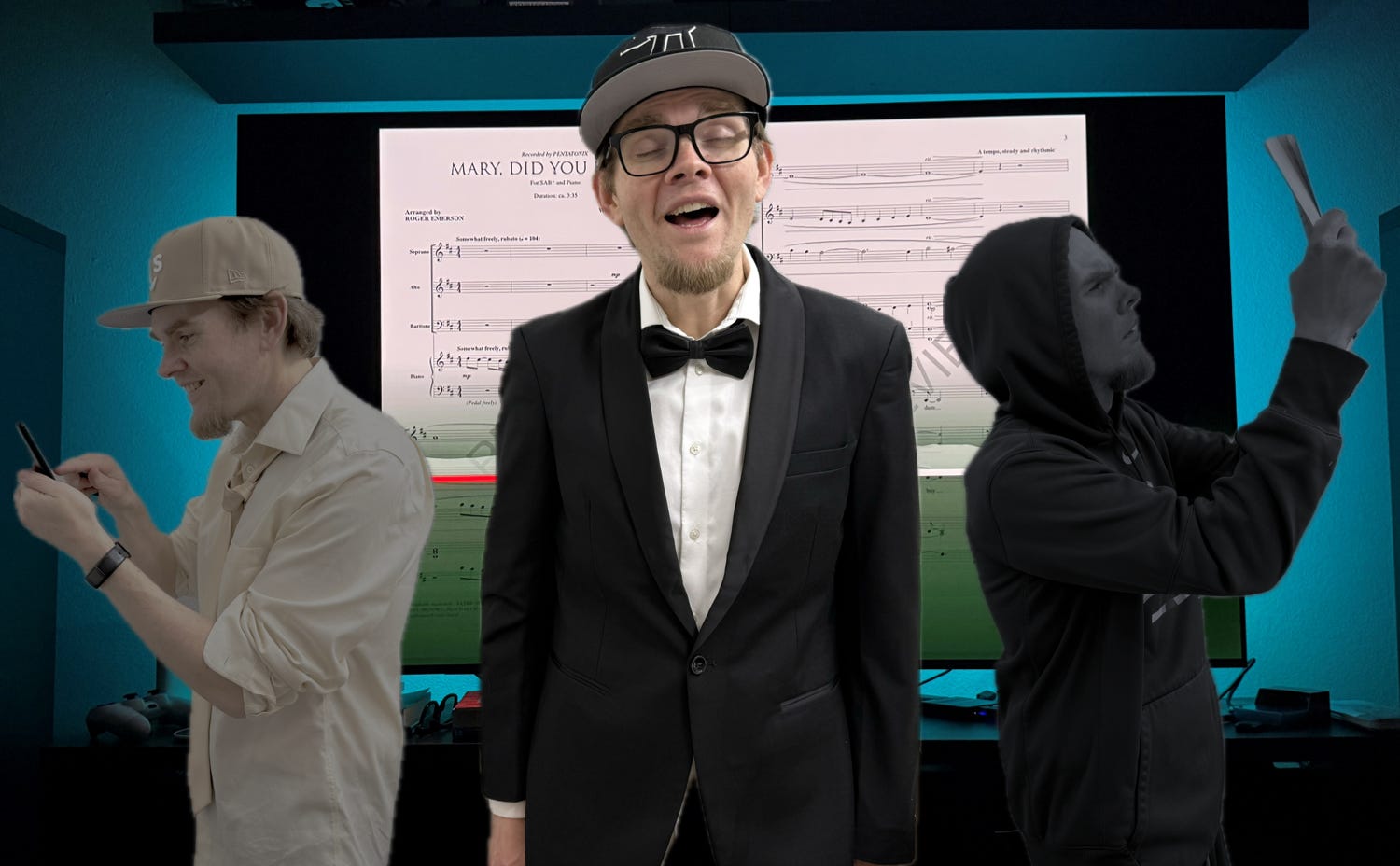
Abby first invited me to sing with Vocal Ensemble in 2016.
The invitation carried the lowest of low stakes. The song would be the ubiquitous standard “Carol of the Bells”, they’d tuck me away on the back row of the risers, and I’d only perform at one of their two holiday shows. That was perfect; even the shortest stint on stage, enveloped by a choir’s harmonies, would be a treat.
I didn’t get nervous before Coleen, the director, called me onto the stage that night. That afternoon, I’d slipped into rehearsal to sing through the piece. I’d practiced it a few times at home, humming along to an old recording from high school, but standing next to Connor and the other basses, the song was immediately present. I’d sung “Carol of the Bells” during every holiday concert as a teenager, which means I’d rehearsed it dozens upon dozens of times. I knew that song.
And I sounded good on it. The bass part carries the melody for a spell, something Souliere always relished, and the rest is all foundational dings and dongs at the bottom of the clef. It’s not a difficult song for basses. We nailed it that night.
I’ve sung with Vocal Ensemble every year since. Most years, I’ve sung “Carol of the Bells”, but a few years have seen me contribute more. I got one verse of “Since U Been Gone” during COVID and emceed their live-streamed telethon in 2021, but I’ve also performed solo pieces twice. No matter what role they requested, I enjoyed it. Every concert was an annual highlight.
But my performance was never the highlight for me. Amid all my music and theatrics, my favorite part of each concert experience was inevitably one I witnessed from the audience. During every holiday concert I can remember, the Vocal Ensemble has performed the Roger Emerson arrangement of “Mary, Did You Know?”, a Christmas song first recorded in the early 1990s. I had never heard the original, nor had I listened to this version popularized by the Pentatonix. The Vocal Ensemble marked my first exposure.
It’s an incredible piece. When I write about crying during the holiday concert, this is almost always the piece I’m writing about. “Mary, Did You Know?” features tight harmonies and a gorgeous texture that sweeps across the octaves. Every part fronts a few measures of melody, and that means every part also assumes a supporting role. Performed a cappella, the song has an ascendant tenor line that evokes Lauridsen’s “O Nata Lux”, but also an incredible bass line that moves from belting out moving lyrics to providing the rhythmic thump underneath. There’s a little Eric Whitacre in here, too, with each part swirling around the others like a warm ocean current, but Emerson and the lyrics ensure the work’s accessibility. It’s a song about wonderment and awe, about an incredulous conversation with the mother of the messiah. The piece nails that raw emotion and spectacle.
It suffices to say that I’ve left every winter concert buzzing after my performance, but humming “Mary, Did You Know?” instead. There’s no surer sign that Christmas approaches than the Pentatonix blasting in my car, and me rumbling out a crude approximation of that bass line I wish I could be singing.
It’s true: I did wish I could sing “Mary, Did You Know?” every December. I was content with my annual cameos, of course; don’t get me wrong. But hearing that song was nostalgic catnip, harking me back to the best parts of high school. I remember performing pieces like “Mary” that crushed audiences under a tidal wave of intricate, moving harmony. As much fun as listening to that sound and being moved by it is, I missed contributing to it. How could I not?
This fall, an opportunity arose. Two of my Calculus students, L and H, extended an invitation to sing with Vocal once again. Initially, I assumed they meant “Carol of the Bells” as always, but the next day, they handed me multiple packets of sheet music. I started to refuse on principle—these were their songs for their concert—but then I noticed the sheet music for “Mary, Did You Know?”. It was right there in my fingertips; I could actually see the bass notes. If there was any resistance in me, it evaporated when my fingers traced that opening line.
I passed on the bouncy, alumni-favorite “Jingle Bells”. I accepted “Mary” with a grin on my face.
This was October; the concert would be in December, so I had time to prepare. Coleen emailed me a part-recording track, and I used that once a day for a month to prepare. The piece was tricky, particularly for a rusty singer like me, so I ramped up my efforts during Thanksgiving break. After several daily runs, I felt stronger. I couldn’t project on the lowest notes—there’s a low E in there—but I knew my part. I was eager to join the Ensemble.
On the Monday we returned from Thanksgiving break, I headed into Vocal’s fifth period rehearsal. Despite knowing only half the group personally, I got a glorified celebrity welcome. They were so excited to hear me sing. No pressure.
I joined them for warm-ups and then sat down for “If I Had My Way”. What had been tempered nerves flared up during that number because listening to the harmony at such volume and proximity brought me to tears right there on the piano bench. But then it was time to sing, so I popped up, took my place in the very center, and sang “Mary, Did You Know?” while surrounded by a talented group. It was a dream come true.
Well, except for one small problem:
I sounded terrible.
*****
I’m probably overstating things a bit. I have enough choral experience that my floor is pretty high. I possess a mature voice and strong ear, and the richer vowel sounds new singers work to achieve are typically my default. Setting aside my limited sight reading and rudimentary music theory, I’m pretty good. My voice instantly adds something to even a strong group of high school singers.
But that baseline competency isn’t enough. In harmony, one person being off wrecks the entire Ensemble. During my last Honor Choir, the director sent out chaperones to hunt down some guy dropping octaves; Jeffrey once ran the same three measures of Carmina Burana at least ten times until a specific tenor dropped out. The idea of weaving voices together is to build something beautiful together—nobody wants to be the shaggy knot interrupting the pattern. And that’s especially true for a glorified ringer brought in at the end.
Still, merely wanting to be better wasn’t enough; I needed to do something. Coleen had asked me to return on Thursday, so I had roughly three days to put a plan in place and turn things around.
The challenge, though, would be improving with the same tools I already had. Coleen’s part-recording isolated my notes to help me get them down, but I had already used that. I needed to change something or risk reinforcing the same issues that led to my subpar performance.
I started my work by weaponizing a different part-recording from Coleen. That morning, she had shared a YouTube video with the full performance of “Mary”, so I began using that relentlessly.
Small as it might seem, that video’s platform alone made a massive difference. My prior part-recording was a downloaded MP3, so it only played in the Files app. While this was fine, the app didn’t offer a looping option to play it on repeat—YouTube did. When I got home on Monday, I looped that video and sang along a dozen times before dinner.
That practice helped me zero in on my struggles. Having run through the piece in full context so many times, I recognized that I didn’t sound terrible everywhere. I excelled with the melody, having locked in on it quickly after a decade of winter concerts; my voice probably came out too strong, even. Likewise, I nailed all of my entrances, oddly syncopated though they were, and of course, my vowels and enunciation sounded passable to my ears. That stuff was solid.
My struggles came from a quintet of isolated issues:
I could find my starting note on page twelve, but not when to leave it.
I lost my part during the post-melody rumbling on page eight.
I mixed up “doo” and “doom” during the interstitial sections.
I hadn’t noted dynamics, so I missed crescendos or came in too hot.
My aging voice couldn’t project on the lowest notes in the piece.
Armed with this insight, I set about to repair everything I could.
To address my rhythmic failures on page twelve, I stuck to YouTube. I knew my notes, and I knew their scripted timing—dotted half-note, then two half-notes—but I couldn’t land that pattern while the full Ensemble’s other parts swirled around me. Thus, I stood in front of my TV and replayed that section over and over and over until I could.
Did I do it twenty times? Thirty? It was probably more. Each repetition let me place my timing within the collective more readily. The larger structure took shape.
Eventually, I found that if I counted 1-2-3 in my head alongside that dotted half-note, I could feel the beat within the music. Once I did, I paused the video, sang it to myself ten times, and then returned to the recording. After several trials starting at that section, I felt satisfied, so I sang the entire song through several more times. On the fifth, that section, at last, felt automatic.
One flaw down.
I undertook a similar plan with page eight’s rumbling conclusion, relying on repeated plays of that specific section. There was no YouTube this time, though—not at first. To ensure I knew my notes well enough, I repeatedly rewound the bass part-recording to the melodic run’s final notes. Those bass lines are all doos with recurring rhythms; everything sounds alike.
Over time, I discovered that I actually knew those tricky measures better than I believed: they just felt weird. Most of that section consists of alternating dotted quarters and eighths, which makes the half-notes, quarter-notes, and rests at the end awkward. Using the sheet music to visualize the odd rhythm and the part-recording to focus my ear, I practiced until I could sing my line a cappella from memory without hesitation. I then returned to full-piece practice on YouTube to get it down within the harmony.
That worked. Two down.
The third and fourth issues were the most straightforward to attack. For three, I inspected the sheet music to identify and memorize the pattern. After reading it aloud, I finally realized that the basses sing “doo” in the first two sections but “doom” in the final two. This lent splendidly toward a mnemonic device: we start with “doo” and add an “m” the more we move forward. Done.
Likewise, for the dynamics issue, I did what I should’ve done earlier: closely read the text. I’d been so focused on learning my notes that I neglected the rest of the score. Taking care to note the marks floating above the staff, I highlighted a few specific spots to integrate into my practice. Knowing that Coleen would be conducting these (and that my section would obey them, too), I trusted this issue to mostly take care of itself—but a few minutes’ study never hurt anyone.
Onward.
But that left my fifth problem, and it was a doozy. Although I sang Bass II in Honor Choir and high school, that really isn’t my skill: I live in the higher baritone register where my range extends enough that I sang tenor during college. Still, aside from that low E, “Mary, Did You Know?” was well within my range…twenty years ago at nineteen. At 39? I hit most notes, but they came out weak. Like an engine running in a distant neighborhood.
After that first rehearsal, my vocal limitations had demoralized me. The pitch often sags when singing a cappella, but even a sliver of flatness could be fatal for my audibility. Moreover, even if the pitch remained perfect, I still had to stare down time: my voice is older. It might not be capable of the feats it once was without blinking. Perhaps this was one issue I simply needed to accept?
I went to bed that night aware that I had polished everything up significantly, but the aging cloud hung over my bed. How could I lower my voice down to All-State Honor Choir level in three days? There’s no way it—
Except there was. There was a method that would lower my voice, and I knew this because it had happened in 2002 at Honor Choir. When I arrived on Thursday, I could barely scratch the lowest notes in “O Nata Lux” and “Der Gang Zum Liebchen”. I lamented this fact to Jeff, the tall senior from LA seated next to me, and he laughed. Jeff told me not to worry.
“Your voice will be stronger on Saturday,” he said. “You’ll get there when it matters.”
Damned if he wasn’t right: after two days of eight-hour rehearsals, my range expanded. My vocal cords were fatigued, but that extreme usage left me capable of notes I would have coughed out otherwise. Singing and singing and singing for hours at a time would train me.
So that’s what I did for “Mary”: I sang it every minute I could. I hummed it before school between discussions with Kim. I sang it under my breath in the pod while working. I did two runs driving home from school. And whenever there wasn’t food in my mouth, I was opening that mouth and powering through gorgeous music. After two days of this, my neighbors could have joined me on stage. Surely, they’d learned my part, too.
When the concert arrived, I got to do the complete lead-in and warm-up for the first time. Although my eyes instinctively clung to Coleen, soaking in everything the director said about logistics and sound, I also peeked around the room at the students. Their faces glowed, a mix of excitement and nervousness always present. I’m sure mine looked the same.
“Mary, Did You Know?” was the evening’s fourth number, and I walked out and took my place with renewed confidence. Three days earlier, I’d been embarrassed by my sloppiness, but intensive work had transformed me on the song. If this were to be my one shot at “Mary”, it would be a good one.
It was. The Ensemble sounded good.
I did too.
*****
I thought a lot about process after last week’s concert. The audience that night got my finest rendition of “Mary, Did You Know?”, a performance demonstrably superior to what I’d bleated out at Monday’s rehearsal. I heeded the dynamics, I nailed once-problematic sections, and I even found sufficient range for every note above low E. Everything I did to prepare paid off. It worked. Everything.
Coming off the stage, students told me I’d sounded great; I believed them. The whole piece had sounded great around me, and I felt strong musically in a way I haven’t since my National Anthem at the River Cats game. That was all I wanted: to sound good on a favorite piece of music. I’d done that.
But perhaps I’d misled the students I sang with on Thursday night. It always irritated me how the 2000s TV series GLEE! characterized musical preparation on screen. Inevitably, the gang would arrive in Columbus for Regionals or in New York for Nationals and still be undecided about their set list. One year, Rachel and Finn literally wrote an original number in the hotel room! Although I understand that TV shows are fiction, it irked me that GLEE! eschewed even a thirty-second montage. In that universe, talented people needed no clock hours to achieve mastery. They vomited out musical notes and, voila, here’s a trophy.
Unfortunately, when I walked onto the stage and sang “Mary”, I pulled a GLEE! with the choral program. Although I’d practiced regularly for almost two months and then intensely for a week, that work went unseen. They didn’t see me scowling at sheet music. They didn’t hear me hammering out doos in the kitchen or berating myself for sluggish tempo in the pod. I mentioned my practice whenever I could, but most of them witnessed a veteran singer waltzing into two rehearsals before nailing the piece on stage. To them, I was some musical savant, a glorified guest star on GLEE!, not a grinder who needed six focused hours to sound solid.
That’s too bad. I know effortless brilliance is all the rage these days, and that we can automate “creativity” and “communication” with a few taps in ChatGPT, but I hate it. I hate that the intricate process I adhered to got buried behind its results. It’s so boring if I’m great immediately! The story here is intentional effort. There’s meaning to mine from all the time I put toward mastering 235 musical notes.
Why did I grind through reps of “Mary, Did You Know?” last week? There are so many reasons! I wanted to honor H and L, who invited me, by sounding good alongside them. I wanted to repay Coleen’s contributions to the Diamond Day program by giving my best effort on her program’s big night. I wanted to honor all the Vocal leaders and singers who’ve kept me involved over the last few years, beginning with Abby. More selfishly, I wanted to relive the joy of being on the risers under the bright lights and feel the wave of satisfaction as cheers and applause washed over me, knowing that I had done my part to inspire that reaction. All of these things required me to be good, and that meant I needed to practice until I was. It’s a simple calculus, really: those things are worth so much to me that I will trade my most valuable currency, time, for them.
As I think about it now, though, it dawns on me that perhaps there’s another reason I got so into the process of learning the music. What I love most about these annual opportunities is that they pull me into the orbit of our Vocal Ensemble. Even though my musical highlights happened twenty-four years ago, long before they were born, being around these singers reminds me of those times. I remember the pre-concert jitters and the chatter between pieces and how big it all felt. I loved every bit of it in 2001 and 2004. I still love it in 2025, just like I loved it back then.
But it is funny what parts from back then I think about the most when I’m around the choral program. Even when I’m at a concert and surrounded by formal attire, a packed house, and professional lighting, my mind doesn’t drift to the concerts I sang at. I don’t dwell on the gorgeous songs we sang, either. I don’t think about the car rides or bowling or any of that.
What returns to me most powerfully is rehearsal. I remember singing in a U next to the talented musicians who became my friends. I remember listening to incredible pieces come together one part at a time and gradually finding my notes in the others’. I remember Souliere at the piano or conducting with Finale chiming behind him, or Robyn teaching us our part on a keyboard in the closet. I remember developing crushes on sopranos and arguing with altos; I remember the sting of criticism when I screwed up and being moved to tears by an original composition.
The best times I had in high school weren’t performing the music on stage but learning it during rehearsals. I’ve been on plenty of stages since then, but nothing ever matches the feeling of assembling harmony with people you love and knowing that there will be something beautiful as a result of your work.
If there’s one thing Vocal Ensemble taught me, it was the value of good process. You start the quarter with the goal of performing a few challenging songs for the world. In the beginning, you muck up the notes, mess up the rhythm, and blow through the dynamics. You sound terrible! Nobody wants to hear that! But then you practice and practice and practice—and then you loop back and practice some more. You run the shoddy sections until they’re sharp, you hammer out the notes until they’re nailed into your memory, you sing and sing and sing again until what sounded like crap four weeks earlier sounds like heaven instead. You practice until your voice moves people to tears.
Singing “Mary, Did You Know?” with the Vocal Ensemble marked a special achievement for me. Forever onward, when I listen to the Pentatonix version, I’ll recognize the bass part—now my part—in the gorgeous chords. When I do, I’ll think about this concert and the musicians who generously shared their stage with me.
But I’ll also think about the work it took to know that bass part. At fifteen and sixteen, I couldn’t appreciate how much singing with the Vocal Ensemble taught me, but I can now. Singing a great song on stage is wonderful, but so too is perfecting the notes so that they’re special when you finally share them with the world.
I know we’re all busy, our time at a premium, but damn, were those hours learning music worth it.
In 2001 and today.
Roughly 1600 words hit the chopping block from this piece on Friday evening. I had tried too hard to make this about process and journeys—it is about that, but the focus had to be the music. I love what writing this helped me realize about the power of learning music and my time in Vocal Ensemble, both then and now, but there will be another time to write about the importance of approach. For now, everything’s about the music.
We’ve got one week left, and as always, I’m getting run down as final exams approach. But I’m excited to take an even deeper breath than Thanksgiving offered, and I’m especially excited to catch up with friends, watch movies, get ahead on notes templates, and do my year-end reflections. Still, I’ve got two pieces left before I can sell out for that, so here’s to those turning out well.
One last note: if you’re interested in the piece I wrote about here, you can hear the Pentatonix version here and the rehearsal video I grinded here.

I feel like there quite a few areas we share in common, but unfortunately for me, singing is not one of them. Nonetheless, what I took from your piece is something that I think crosses almost all domains. You spoke of the joy and value of not just nailing the song, but of learning it, of mastering it. This is something I not only know well, but that I love. Whether it was putting in countless hours to master the movements of skate trick or spending far longer than most would deem reasonable to craft the right words for a sentence — I think being in love with the process, even more than the outcome, is something that helps ensure whatever you engage with keeps on supplying you with that magical stoke.
Your piece also reminded me of something I think I’ve mentioned before, but it always bears repeating— the value of piece of art is not in the art itself, but what it did to the artist through the act of creating it.
Also, this line made me giggle: “After two days of this, my neighbors could have joined me on stage.”
Thanks Michael :)
I am so very happy that you get the opportunity to revisit the joyous times of your choir days. It is quite the gift! Although the cost in time is high, the reward is priceless memories from the past relived and from the present newly created to look back upon in the future. To me it seems like time well spent.