
Volume 7, Entry 15: Stiff Upper Lip
Subverting the Be a Man box

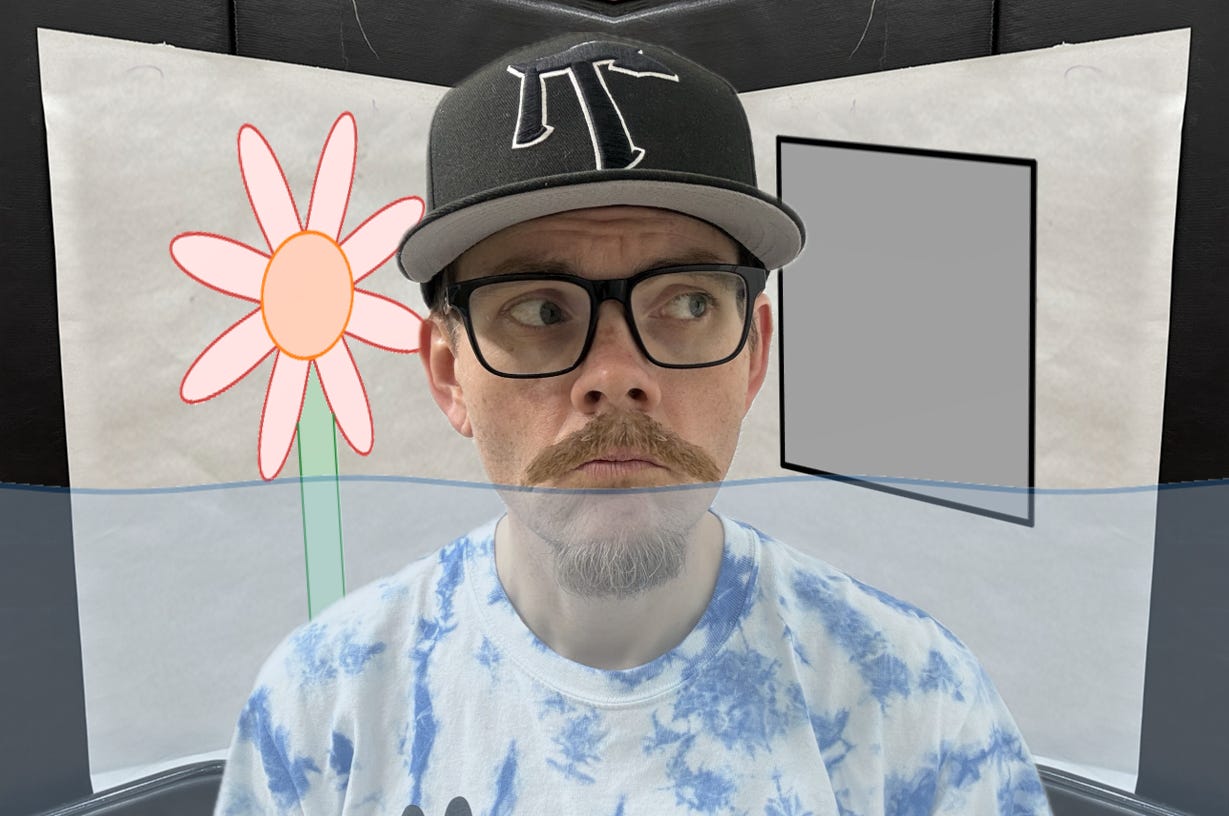
I started growing a mustache during spring break.
I’m no stranger to facial hair. In high school, I sported a thick beard beginning my senior year. The hair came in fair, never blonde so much as a faint auburn, so I had to grow it thick to make it visible. This shagginess suited my habits: I rarely shaved, chasing a look that would grow popular among MLB players. But tufts on my cheeks inevitably became itchy, so I almost always trimmed those beards down. I let the hair surround my mouth, hiding my non-existent chin behind overgrown stubble, and that was it.
Since June 20051, I’ve worn a goatee. It’s about the width of my mouth, roughly an inch in length. My chin’s more defined these days, but I like the shape the beard lends my head, particularly while I wear a hat. It looks right to me. It’s one of the good parts of how I see myself.
The same can’t be said about the mustache. My dad could never grow a mustache that wasn’t the color of old applesauce, so I tended to associate them with the abrasive coaches who turned young me against sports. They were the mark of sheriff’s deputies and lawyers who took away water breaks and sent me running after every error. While my late cousin wore one with his goatee to hide a baby face that must be genetic, I mostly saw them on older men. I found no compelling reason to deal with an unruly mess above my lips.
Especially now that I’ve got gray hairs popping up. Despite my being pretty open about turning forty, people still struggle to peg my age. I got a guess of thirty just last week, but a mustache threatens to betray the truth. Dollops of gray sneak in, and they’re always too central to cut out.
Granted, that gray’s actually an asset this time. My initial purpose behind this mustache was to project age: I’m trying to make the cover art for the printed volume of last year’s Intensely Specific. After holding a hand-drawn balloon in 2023 and tossing a hand-drawn baseball last year, I’m planning to act out a scene from “Juanita Verde”, complete with a dad hat, beach attire, and hand-drawn starfish. Oh, and of course, a mustache. I want to look like the fictional me who narrated that parable, so I need to look older. A mustache helps.
Unfortunately, the hair on my lip grows at a snail’s pace. I intended to grow it for only a few days, ten at most, but my hair follicles haven’t cooperated. I’m just now at a point where it’s visible, but it isn’t close to the bushy Man Carrying Thing-esque caterpillar I had in mind. I’d love it gone, but I’m too far in. I already formatted Volume 7’s interior—I want that physical copy complete!
The timing of this episode meant an unintended consequence: I led Diamond Day on Saturday with a clear, visible mustache. No big deal, of course, right? Who cares if the guy on the mic has a lip toupee?
The answer wouldn’t have been me…except the more I thought about this stupid mustache, the more I came to wonder if it wasn’t actually an asset to the program I delivered. That’s a weird thought, I know, but bear with me.
I think there’s something to my whiskers.
*****
When we hosted the first renditions of Diamond Day entering 2019, I had a co-facilitator, Axel. We divided up the script, choosing segments that suited our personalities and lives. Although the job-share changed in 2022 when I ran it myself in a pinch, the outline I still use retains that prototype’s influence: it’s why half the text is purple, the other half green.
Co-facilitation was a great setup at the time. I wanted to work with Axel to honor their impact on me, but I also didn’t feel equipped to lead the entire program. I wrote our Cross the Line, for instance, but Axel narrated it—I loved that. Their control meant I could participate and both offer and receive support during it. That was awesome.
The bigger asset was ceding a sequence about gender to Axel. Gender played a more central role in their adult life than in mine; they were an authority on the subject in a way I will never be. I lacked their experience and conviction.
Leading on my own four years ago, I skipped that sequence entirely. Given one night to prepare, I couldn’t wrap my mind around what I would say and why. To stand at the front of a room expecting Challenge Day’s professional polish and instead getting me already stoked impostor syndrome; why exacerbate it further by speaking on a topic outside my wheelhouse?
No one faulted me for trimming a few sections from the script under pressure, but several veteran attendees did note its absence. All urged me to bring it back if we continued the program, which we did. So I did.
The twin cores of this segment are a pair of simple illustrations. As a means of explaining why so many people hide discomfort and shove their troubles into bulging emotional balloons, I begin by drawing a rectangle labeled2 as the “Be a Man” box. In that figure, I record the lessons young boys learn that discourage them from dealing with things healthily. After jotting down a few from my own upbringing, I invite the attendees to volunteer their own. They offer many.
But it’s obviously not just men who internalize counterproductive gender norms. Women do, too, often from alarmingly blatant cultural artifacts. For the women, I draw the “Be a Lady” flower. In and around it go all those lessons young girls take in regarding how to be and behave in the world.
All of this is borrowed nearly wholesale from Challenge Day, so it shouldn’t surprise anyone that it works, but it does shock me sometimes how much consensus there is around the expectations we’re taught implicitly. When I’m calling for contributions, the crowd is all nods; they’re eager to put to words something they understand well but rarely voice. We do a lot more talking about gender norms nowadays, but those conversations often turn contentious. Perhaps it’s the arena, but this presentation feels no more controversial than pointing at a duck and saying “Quack”. Even when I draw a line below the two figures and describe gender as a spectrum, it feels utterly unremarkable.
But let me pause right there for a moment. Despite invoking the “Be a Man” box and “Be a Lady” flower just now, I haven’t mentioned any of the norms that get called out during my presentation. It’s rare that I ever linger on them; participants throw out the same things every time, so I don’t dwell. There’s too much personal and powerful stuff to discuss instead.
For whatever reason, though, I noted the norms more intentionally on Saturday. My initial pitch while transitioning in was “Show no emotion”, as a nod to the social stigma I felt regarding my penchant for big feelings. I could show emotion after winning a championship, but only a little, only then, and only when accompanied by ironic self-awareness that I shouldn’t have. Men, as I was taught, embody action over feeling. My sentimentality set me apart from my male peers. It made me weird. They made sure I knew that.
The bullet points didn’t stop there. “Endure pain” and “Be strong and athletic” came up soon after; I mentioned my dad then, the three-sport superstar who once limped in with blood gushing from his leg to politely ask for a towel. He needed nine staples, but he was, with a grimace, “Fine”.
The list goes on and on. Men must be “stoic” and “leaders”. They must be “smart”, “charming”, and “confident”; they need to be the “breadwinner” to avoid the emasculation of being out-earned. They can display “anger” but not so much that they become “violent”, unless, of course, they’re “forced to fight” in which case they must be “aggressive”, “dominant”, and “hard” because men must be “winners”, and that’s what it takes to emerge on top.
Most prominently, though, there’s one thing that’s shared every time I’ve done this. Sometimes, it’s a boy who volunteers it, but other times, a girl helpfully chimes in. It’s the subtext of the one I added first, but it’s perhaps the clearest mandate among all the gender prescriptions I grew up with.
“Don’t cry.”
Between Challenge Days and Diamond Days, while attending and facilitating, someone always says that men aren’t supposed to cry, and I nod right along with it. It’s true: my tears met repugnance even at a very young age. Crying boys drew scolding and derision from male neighbors; relatives wrung their hands over their sensitive, weak grandchildren prone to weeping. They taught me to stifle my tears; I trained myself to cough or exit the room during heartfelt moments to avoid the awkwardness. Yes, others consoled me and insisted my reaction was okay, but they were all women. Not all women, mind you—the cruelest condemnation of male emotion I ever heard came from a woman—but enough that their compassion only served to reinforce the gendered nature of my emotionality.
One of the reasons I think I shied away from addressing gender in this obviously productive way was because of how much it stings. I land dreadfully short of so many of these norms that discussing them feels like outing myself. It’s like I’m playing Hide and Seek but FaceTiming with the kid who’s “it” all the while. Why remind myself of how poorly I fit the role I was born into?
Last Saturday, though, despite everything in this segment going precisely as expected, I finished my address and had an epiphany. That discomfort I feel with the prescribed tenets of manhood actually enhances my presentation. Everything pivots when I begin my monologue, and I suspect that those norms serve as an asset to what I aim to achieve with Diamond Day.
Because those norms give me something to subvert.
*****
To make sense of what happens after I talk about gender, I need to explain what I do before that.
Diamond Day opens with a sprawling series of icebreakers. There’s dancing and high-fiving; we play games interwoven between structured conversations on no-stakes topics like breakfast and TV. Although there’s a lull when I narrate the norms, there’s basically no other: it’s one high-energy, safely-social activity after another.
Setting that tone is me. Although I act goofy during my classes, cracking jokes and enlisting ridiculous metaphors and allusions throughout, I’m not a high-energy person. I feel phony wearing a cruise director cap and cosplaying as an emcee; those are bright and glossy roles ill-suited to my earnest energy. The performance part of teaching—the having eyes on me, the being engaging for sometimes petty almost-adults—is my least favorite part of the job. And running Diamond Day is nothing but performance. It’s 100% entertaining, vamping, and dancing around for teenagers’ bemusement.
But I sell it pretty well. On Saturday, I told the adults in attendance that they’d be watching a magic trick: I would pretend to be an extrovert for the next seven hours. If I did it well, they’d leave thinking me a liar.
The student participants don’t hear that, though. I play it straight with them all morning, becoming Ryan Seacrest meets Tony Robbins meets Tigger. What they see is a social butterfly who dances without any moves, who runs around their giant circle of chairs, cracking wise every other sentence. I’m a ham who sings “I Want It That Way” like he’s auditioning for American Idol. Sure, I’m self-deprecating often—crowds love laughing at a dude when he leads the chortling—and moments of sincerity sneak through when I pay compliments, but mostly, I deliver schtick.
Until I stop. There’s a subtle change that happens after our mid-morning break when everyone slips into groups. They can’t cling to their friends anymore; they can’t sulk on the edges and avoid others’ eyes. They’re asked to hold hands, and nearly all of them do, but then they get to play another game together, and some of that stiffness melts away.
It’s right then when we pull together into a tight half-circle. After a morning of mostly them talking, a half-hour of my voice commences. Usually, I warn them that the tone has changed, but I think they get that memo automatically because I stop moving around. Pinned into place by their chairs and their bodies, I stash the microphone and start talking about emotions, gender, and mental health.
I’ve never heard myself speaking during this segment. Courtney recorded my first two, so video footage exists, but I don’t need microfilm to recognize the smooth transition I’m presenting. In the more intimate half-circle, I still kid around, exaggerating my gestures and inflecting my voice, but without the microphone, my voice no longer booms. There’s no music here either, so my words sound small against the cavernous gym. What I say becomes more personal, too—I start with the Be a Man box because I’ve lived it. My examples hew closer to my life. If I get it right, I trade being the emcee for becoming some guy.
After talking about the gender spectrum, I reprise the image that convinced me to attend a Challenge Day in the first place: an iceberg. I repeat a (probably-fake) statistic about only 10% of an iceberg being visible, and then I connect all of us to icebergs. The part we show “above our waterline” is our front-facing image, the character we project to other people; the part distorted below the rippling water is our true self. Just as Jen’s PowerPoint3 put it sixteen years ago, I label the latter REAL and the former FAKE to emphasize the challenge of hiding who we really are below. Pointing to REAL and FAKE, I explain the dangers of living as our image, and I extol the restorative power of lowering one’s waterline. The more real we are, I note, the greater our chance of genuine connection.
And then I fully open up. Using the sentence starter “If you really knew me”, I talk about myself from below the waterline. My typical opening begins with an anecdote for context, no different than how I write here, but then I delve deeper. You can almost feel the waves dropping as I mine my psyche for stories and reflection that illustrate the person hidden within the extrovert they’ve been watching.
If you read my stuff here, you’d recognize many of the topics I bring up. In 2022, I discussed the claustrophobia of being at school post-COVID and the optics of wearing pink. At other events, I’ve talked about the pressure to do more, the hollowness of being childless, and the frustration of making a small impact. At Saturday’s event, I addressed body dysmorphia, marking my first time speaking about the topic with any detail in public.
During nearly every one of these addresses, I get choked up. I never aim for tears, but they almost always arrive. Regular reflection has normalized talking about suicidality and self-loathing for me, but that isn’t true for my audience, particularly its youngest members. It’s possible that, for some, they’ve never heard an adult talk openly about their own struggles; thus, when I open up, something stirs in them. And I see this while I’m addressing the room, by the way. I see evidence that my words are moving them as silent tears roll down their cheeks.
Certainly, my specific words on specific topics do move many people. All this writing has made me a compelling speaker about the subject I know best: myself. But I think there’s something more profound happening when I talk. It’s something unintentional but effective all the same—and it’s where my mustache comes into play at last.
Because I address the Be a Man box a few minutes before giving my personal address, I front-load the listeners to be acutely aware of debilitating male gender norms. Literally right behind me on the wall hangs our collected list, so the taboos against men acknowledging pain, showing emotion, and crying are front and center while I do those very things. My mustache renders my masculinity irrefutable, yet I defy all of those norms with my words in a moving fashion. This contrast disarms people.
Those gender norms become an entry point. No matter what I talk about, I’m contradicting something they’ve already seen. I exude spirit and warmth all morning, but then I’m crying. I move and lead with confidence, but then I’m anxious and uncomfortable. I’m surrounded by people, but then I’m alone. Every bit of honest emotion I offer reinforces the iceberg: the person they’d figured me to be was my image, not me. I become a model for that dissonance between who we are and how we’re seen, which stokes awareness of our own chasms. Suddenly, everything is different because the person talking hasn’t actually changed, but how they see him radically has. Because he lowered his waterline for them.
The change afterward in them is incredible. By speaking so personally, I demonstrate the creation of intimacy. I pry open one of my wounds and invite them to inspect it to show them how it’s done. They feel closer to me, so much so that a quarter of the students lined up to hug me before they returned to their groups on Saturday. That level of connection shouldn’t be possible—I’m talking about myself for ten minutes!—but that surge of closeness provides twin proofs of concept: connection can happen with anyone, and you are the architect behind it. Whoever you are.
Which is the entire point of the event.
*****
When I break down the mechanics of the monologue like this, there’s a danger of it seeming manipulative.
The remarkable design of the Challenge Day program that inspired ours shines through here. I recognize why everything happens when it does now in a way I couldn’t articulate before Diamond Day’s debut. The students who outlined the program with me did excellent work. We kept the right parts and added quality supplements.
But is it manipulative? I’m going to push back on that. I’d personally call it “disarming” because I truly believe releasing feelings from over-taxed emotional balloons benefits people, young and old. If my address puts any pressure on them to do something they otherwise wouldn’t, blame it on the bloated helium in so many of their chests. Even slight pressure can knock the wind out of them.
Besides, it’s not manipulative when I’m fully transparent about the purpose of every item on the itinerary. I narrate my intentions before each segment, and I demand nothing in return. “There’s no right or wrong way to do this,” I remind them. “Anything you share is great.”
Most critically, I’m not massaging the truth while I address them. They hear genuine stories and authentic reflection; I speak well, but in a still-unpolished manner that proves I’m speaking from the heart, not reciting a pre-written monologue. You can’t forge my realness. That’s why it works.
At least in the program I run. Before the final Challenge Day I attended, one of the facilitators issued an odd instruction to the volunteers. “Don’t talk about yourself today,” he told us. “This isn’t about you. Talk about when you were a kid or something.” These orders bothered me that day, and they continue to bother me years later.
I understand why he gave them. To the facilitator, the purpose of an event like this is to help young people struggling right now. The program is a big-hearted intervention meant to super-charge access to a sense of community at school. His goal is all about immediate relief. He believes hearing adults share right-now-relevant experiences is the fastest way there.
What I think he misses is how vital true authenticity is to forging connection. Similarity can be a social lubricant—that’s a place to start a conversation for sure—but there’s so much nuance in even parallel experiences. Everyone’s struggle is different, even if they bear striking resemblances! Indeed, I would love for every student who attends to match a volunteer one-to-one in every way; that would cast in bronze that any present trials can be overcome. But what I really want is something more permanent than short-term relief. As the proverb goes: if you give a man a fish today, you feed him for a day; if you teach a man to fish today, you feed him for a lifetime.
The outcome I’m after isn’t one delicious meal of empathy and openness but a lifetime’s buffet. I want attendees to leave fully aware that other people aren’t what they might appear; I want them to walk out the doors willing to challenge their preconceived notions. People can surprise you—people like me, first, and then people like everyone else. No matter what we think or see, no one knows what’s below another person’s waterline until they say it. They could be drowning behind their smile; they could be precisely the friend you need. Anybody could be.
The most enriching part of Diamond Day, at least from my perspective, is how I impart this lesson. While the event isn’t ultimately about me since I don’t radically transform by its end, it’s heartening to be both the architect and catalyst of other people’s growth. It’s my deft touch playing extrovert and then subverting it. It’s my personal demons that stoke reciprocal vulnerability. It’s my mustache that certifies my Be a Man box membership, and my tears that undercut its toxic norms to champion a more nuanced spectrum. I’ve fought an endless run of exhausting battles with myself over the years, and that sucks, but I couldn’t lead Diamond Day without the art of war those scraps imparted.
We achieve the principal goal because of my experiences. We achieve the principal goal because of me.
Ultimately, I realize that my entire thesis here was wrong. I started to credit facial hair for making this whole thing work, but that’s low self-esteem talking. It wasn’t the fuzz above my lip that made Saturday’s event effective and inspiring. It wasn’t my mustache that made everything click into place.
It was the man who grew it.
I shouted out Challenge Day several times in this piece, but I can’t stress enough how valuable my regular attendance at their events was. Everything I do at Diamond Day follows their lead. Every single one offered priceless professional and personal development.
Unexpectedly, I got to have a conversation that veered into the Be a Man box this week, and I felt a lot better about this piece after talking to A. In any case, this was a “write-to-learn” piece: I wrote in pursuit of understanding how my masculine-presenting facial hair made my monologue last week effective, but I arrived at a different, more nourishing conclusion instead. This doesn’t work as well if you haven’t attended a Challenge Day or Diamond Day, but…would you like to? Perhaps that can be arranged…
I should never say “I have ambitious plans for next week” because that threatens to jinx me, but I have ambitious plans for next week. We’ll see if they come to fruition and you get something memorable or if I turn to a safer, cleaner topic.
As an aside, I started an Instagram to discuss my art pieces. I began several weeks ago with “Happy Thoughts” and have posted each week since. I don’t plan to follow anyone, but if you’re interested at all, consider this your invitation to follow me at https://www.instagram.com/intenselyspecific/
The Hurricanes got to shave my beard off for clinching a playoff appearance.
Or the “Be a Box” box, as I accidentally wrote on Saturday.
Challenge Day presents this precisely the same way, but I used Jen’s PowerPoint first on what might be the single most transformative day of my adult life. But that’s a story for another time.
I have to second what Evie said — I’m inspired by your vulnerability and willingness to talk about your own struggles. It makes you real. It puts you on the equal ground with your reader (and your students). It helps others feel comfortable to open up.
I also applaud how well you just broached the topic of gender ‘norms’. That is such a hard topic to write about and explore with nuance and you did it brilliantly.
And as a guy who was brought up in some very macho environments, and who also bought into a lot of it — until trying to adhere to some of it broke me physically and emotionally— this resonated with me so much. I mean, fuck man, I want to live in a world where acknowledging your feelings and your pain is seen as something strong. Because it is. It takes courage to share as openly as you do, and I really appreciate that you so consistently do it here.
Thanks Michael :)
This was so lovely to read. I truly believe that if I had even one teacher that had one tenth of your compassion and passion I’d have had an entirely different experience in school. It’s incredible to get to read about your work, it makes me so jealous and so grateful for all the young people who get to benefit from it. And I get to benefit from it too.
Gendered expectations when it comes to appearance are incredibly hard to unpack, and it’s something I’ve been dealing with my whole life so it’s wonderful to hear a male perspective and I’m glad you were able to find benefit from it.
I’m so inspired by your vulnerability, your willingness to harness your own struggles to inform how you help others. It’s something I aspire to do too. It makes it feel more meaningful, like a way to repackage it and take the good that you can from it.
I loved reading this, thank you for sharing!