
Volume 7, Entry 8: Happy Thoughts
Two Ls, Two As, and a Y


I was sad for most of last week.
By “sad” I mean “miserable”, of course, but the point stands. There were definite highlights that included basically all of a Thursday when I was awake for twenty-one hours, but those warm highlights only heightened the chill of the rest of the interval. The cruel twist of joy during a down spell is how effectively it underlines the futility of the rest. Emotional eyes adjust to the darkness, but when a flash of light illuminates what’s been cloaked, we stop seeing through the shadows to frown at what we’re missing.
Dissecting any particular sadness’s origin marks a fool’s errand. It’s always simultaneously everything and nothing, a Schröedinger’s Cat of explication that blends a milkshake of malaise and then asks you to pick out one specific sprinkle. The misery was intellectual, psychological, occupational, social, and surely chemical, too, yet it was also none of those things because it was as much about absence as presence. These are senseless contradictions, you could counter. If so, you get it.
Nonetheless, I know that writing fed into my sorrow. What I wrote last week—both what I posted and what I didn’t—carved a chunk out of my heart. Although I prefer expressing malignant emotion over stuffing it tortellini-style into my abdomen, there remains a cost to painstakingly articulating that sort of negativity. It’s taking the monster in your basement out for a walk: fresh air might do it good, but brace yourself for fresh casualties. Certainly, larger creatures prowl around my heart than those I exercised1 in “Do Us Part”, but the existence of a bigger and beastlier brute doesn’t erase the junior partner’s damage.
Enough metaphor. My point: writing what I did last week contributed to my sadness. That’s fine, by the way—“Do Us Part” is effective art like a Taylor track five—but I can’t reach into the razor blade drawer every week. This week needed to provide a counter-balance. I needed to write about something on the opposite side of the emotional spectrum. Something happy.
With the same instantaneousness that Ray Spantz conjures the Stay Puft Marshmallow Man in Ghostbusters, I chose my anti-destructor in a snap. I could have selected several things—a great movie, a special song, a particular baseball game—but that’s not where my thoughts went. Instead, as they so often do, I thought of a person.
Specifically, I thought of Layla.
*****
One of my pet peeves in the classroom is disengagement.
Granted, that’s probably self-evident. Disengagement is to teachers what Victor Wembanyama’s wingspan is to driving forwards: a deterrent to success. A distracted student playing Clash of Clans or typing an essay for AP Government isn’t likely to learn much math.
But disengagement has an even more profound effect on me, activating an internal interrogation. It takes very little to conclude I’m doing everything wrong, even with the most well-rehearsed and years-honed lessons. At any moment during instruction, I can scan the room and find evidence that I am terrible at what I do via the absent, impatient eyes of several students. Even while understanding their humanness and acknowledging the physiological challenges of screen addiction and general burnout, it still doesn’t feel great to see proof of your professional failure.
Granted, if I’m not careful, I can inadvertently round every student down to disengaged. Part of that owes to my psychology, but another part owes to Layla setting the bar so damn high.
I’ve never taught a person remotely like Layla. Setting aside everything else I admire about her (and will address in due course), it all began with how she worked in sixth period Calculus AB.
From a seat in the front row, maybe four feet from my desk, Layla treated every word I said like she was Moses receiving the Ten Commandments from God in heaven. That’s hyperbole, of course, but not to the level you might think. Layla sat upright in her spine-murdering student desk with wide-open eyes. Her active listening defined the term: slight lean, head tilt to optimize hearing, raised eyebrows, slight nods when things made sense. She was willing to answer any and every question, not to mention ask when one occurred to her. She laughed at jokes, even the least funny ones, her mirth nevertheless always sounding real.
When the year began, I didn’t think critically about her behavior—I just took solace in it. Hers was an awesome class, one whose photo hangs on the far classroom wall, and Layla deserves a lot of credit for how I perceived them. How could I ever feel uncomfortable in a room that featured her? She paid such rapt attention that it elevated everyone else’s. I felt happy in there.
Which should have been impossible. When Layla first walked into my class, a back injury ailed me. I could barely move! I needed a walker to shuffle to and from the bathroom, I slept on a love seat sitting upright, and I needed rides to and from work everyday. Pumped full of Gabapentin and shuffled between specialists, I should have been miserable, but every day ended in that room with that class and that girl in the front row who radiated kindness like the Chernobyl of optimism.
At some point during the year, I let myself reflect on her in-class approach. By that point, my back had responded to a cortisone injection, and Layla had joined the Challenge Day team, so I had both a clearer head and a larger sample size. It dawned on me that the way she acted in my class was a performance. Every day when she entered Calculus, she chose to become the most fastidiously and magnanimously attentive human being ever. It was an act. It had to be.
That realization only deepened my appreciation for her. I’ve learned many things from Layla, but the first was that it’s possible to give someone your attention. That’s what Layla did during sixth period during eleventh grade and first period during twelfth: cede her attention, focus, and time to me. Layla had a million things she was responsible for simultaneously, all of which ran on the same narrow tracks as learning Calculus from a hobbled man trapped in a desk chair. She had events to plan, speeches to write, floats to construct, and, of course, other classes to study for and perform in to meet the impossible standard of excellence she set(s) for herself, but she checked all of those bags at the door. Each day, she looked me in the eye, smiled, and let her fifty spinning plates crash to the floor. You need this more than I do, her actions said of her time and energy every afternoon. They’re yours.
There’s this thing I do now when a student in crisis talks to me. I lock my eyes on them, I lean forward, I nod my head with the rhythm of their words, and I make my face expressive and responsive, even when they’re looking down or away or crying. Every time they look at me—every single fucking time—all they see is someone whose whole universe has been ceded to them. I hear the noise and I notice the people and I think about all the things I could and should (and would) be doing, but I refuse to acknowledge them because my entire being is with you right now, so you know that even in your weakest moment, you, yes you, are worthy of another person’s every atomic bond being placed in your hands. It takes a few minutes before they realize it, but when they do, well, it’s a damned good thing.
I learned it from Layla.
*****
There was a day during Layla’s junior year when she got sick. I think it was a cold, but it might have been the flu. Whatever it was, she stayed home.
Upon returning the next day, she described her experience as wonderful. That was her word. “It was wonderful,” she said, and yes, she really did include the italics. Although she had been diminished all day, she relished the time off. “I spent an hour on the phone with the venue,” she said, meaning the Library Galleria where her Junior Prom would be held a few months later. “I got everything ordered and finished a potential layout.”
You realize, I hope, that I don’t remember her exact words. I’m surely bungling a fact or tweaking the timeline somehow. That’s the problem with remembering, of course: you don’t. Details fade so quickly, their half-life shorter than Hydrogen-5’s. I don’t remember her exact words from the day she came back, but I do remember how she said them. Her nose still a little stuffy, Layla spoke of phoning vendors and sketching table arrangements like they were a day at the spa. If I hadn’t already adored Layla, I might have found her words ridiculous, but her sincerity overwhelmed my senses. Others’ too—I swear that Layla is someone her peers couldn’t bear to let down because they understood how much she authentically cared about everything, including them.
If you’ve read Sweet Appeal, you probably recognize something in what I’ve just described. In that novel, the main character is a revered class president who relishes the tedious work of event planning and earns overwhelming affection from his peers. What I just wrote about Layla’s sick day could easily have been a deleted scene from Sweet Appeal, and that’s not a coincidence. Although Leo Iskrine’s name came from the words “Love Interest”, his first initial felt more and more apt as I wrote his character to converge with Layla’s. Every time Nate argued that Leo’s earnestness was too much, I countered “I know people like this”, by which I meant “someone” and of course, by “someone”, meant Layla.
There’s far more to Leo than Layla; my character is an amalgam of her and me, not to mention several other people I’ve known, and I picture him as another beacon of goodness I taught at school2. But it’s safe to say that the core of Leo is and always has been Layla in the same way that Hannah maps onto Alyiah.
Granted, making that connection threatens to undermine my enduring affection for Layla. My citing merely two situations obscures the fact that Layla was far more than one random student in a pair of my classes. Indeed, we worked on numerous projects together over the years. It’s been a long time since I thought of her merely in name-on-a-roster terms.
It started with Challenge Day. Because of an invitation distribution error, Layla missed our event during ninth grade. That meant her first appearance came during the fall of her sophomore year. By sheer coincidence, we landed in the same small family group, which is a nice way to speed-run knowing a full person rather than a transcript or resume.
She joined our Student Leader team at the first opportunity, sitting for an interview in which her polish and enthusiasm filled the room. This happened even before Calculus, I realize now, but her warmth and conviction were so on-brand that I only now notice my slippery sequencing. Layla was a person others gravitated toward, but also someone who deliberately drew people in. Struggling students and colleagues’ young kids flocked to her; university-bound classmates gushed about her behind her back. Invoking her name meant impromptu meetings of the Layla Fan Club.
Before her senior year, Brandy and I both considered Layla the ideal candidate to join Courtney as Co-President, but we wanted to respect her packed schedule of activities and spare her the stress of leading another organization. Nonetheless, despite no official title or obligation, Layla helped out with everything, taking shifts at the snack bar and planning the first Diamond Day alongside us. She called in from Hawaii on winter break while Courtney and I assembled playlists. She gave up two Saturdays to attend workshops in Concord.
And, of course, she danced. I got in my head the very silly idea to perform an ABBA song at the musical talent show we used as our main fundraiser, and I convinced Courtney and Layla to join me. While it eventually became the entire team dancing and singing on stage, all the rehearsing and heavy lifting was done by the three of us, which I know robbed Layla of valuable hours. Her dedication was impossible to shake, and I felt bad afterward about the times I was responsible for making her late somewhere because nervous-as-shit I wanted one more run-through. The resulting performance is (and was) special, one of those memories that creeps in anytime I watch Mamma Mia or see the color yellow, but it also marked one of those times when I failed in my mission to reciprocate Layla’s unyielding and unselfish support.
Fortunately (for me at least), Layla didn’t seem to hold it against me. Whatever I needed, she leapt to provide. She’s there mid-air in the front of a High School Musical parody video and smiling in almost every Teacher of the Year publicity still Michelle shot. It was Layla who joined Megha to all but carry me to my car when I ruptured a disc in 2019; it was Layla who recognized my injury’s severity and insisted I go home in the first place. She came back from Berkeley to see Dear Evan Hansen with a bunch of us in 2020, before everything went down, and after COVID struck, we did a several-hour Zoom talk that could have lasted for several days.
It was also Layla whom I called first in 2022 when the Challenge Day facilitators fell ill and canceled. Although Maia outlined it with me that night, and Elena and Megan orchestrated it the next morning, it was Layla that I turned to.
“Can I do this?” I asked, already orbiting my own answer of No and drafting contrite emails to would-be students.
“Of course you can,” she replied, not one beat passing between my question mark and her syllable. “It’ll be even better if you lead it.”
But that time, I called Layla. I reached out to this person that brain surgeons trusted at eighteen to join them during surgeries, who never saw an opportunity to help that she didn’t step up for, but yet, the number of unsolicited kindnesses she rendered on my behalf out of nowhere is staggering. The Christmas cards that hang on my fridge, her flowing red dress in Paris unfurling color against the metallic utilitarianism behind it. The occasional meals left on my porch with notes of encouragement. The wave and smile on the doorbell cam because she was in town and decided to drop off a tin of cookies so I would remember I am loved. I’m forgetting dozens more, I’m sure, and that’s a staggering fact to recount.
Perhaps her most important gesture came a few years ago. Out of nowhere, she texted me the link to a music video by Rachel Platten, one of her favorite artists. That video and song is one I’ve written about before: “Bad Thoughts”, Platten’s piece about overcoming intrusive thinking that builds a familiar breathing exercise into its chorus. In the years that have followed, when the storm in my head arrives at a fever pitch, her song plays on repeat, becoming my final line of defense against self-immolation. It’s worked every time to de-escalate my inward anger and smother my flames of frustration.
Under duress, Platten’s song is an incredible tool—if not a lifesaver—for me, but I suspect that I’ve traditionally given the song too much credit for calming me down. You see, I don’t listen to that song and think about Rachel Platten’s words exclusively. Naturally, I also think of the person who sent them to me and the force of good she’s been in my life. Despite our paths only coinciding for a few years, the goodness she embodies, the goodness she radiates even in my memory, is enough to sweep away several shadows.
How can you not believe in living when a person like Layla exists?
*****
Last week, my Calculus AB classes finally arrived at what’s likely the best lesson I’ve ever constructed. It’s cNotes 36A on the Big Calculus Sheet, and it centers on interpreting definite integrals.
Up to that point, a definite integral has been a geometric construction. In a Riemann Sum, each expression adds up an infinite number of infinitesimally thin rectangles to compute the area between a curve and the x-axis. Although we soon after introduce the Fundamental Theorem of Calculus to wed the graphical depiction to an algebraic algorithm, for nearly the entire unit, we only hint at integrals meaning anything else. Definite integrals are area, basically.
What happens in cNotes 36A transforms that limited purview. We begin with the prior geometric representation, drawing a rectangle beneath a curve, and then we ascribe meaning to it. I call it “tiny little change”, and I draw a coin jar on the page nearby. Four minutes later, we’re performing dimensional analysis using rectangles, first verifying the antiderivative relationship between acceleration, velocity, and position, and then talking about all manner of others including, this year, anti-venom absorption. By the end of the lesson, students can craft complex sentences according to strict grammatical construction, and integrals move from curios connected to quadrilaterals to multi-faceted symbols for change across time.
Seeing as I just wrote several hundred words about definite integrals, you’ll not be surprised that I hold the central concept of Calculus II in high regard. Accumulation is a metaphor I’ve invoked before because it feels so apt to how living works. Over many years, we become an accumulation of our experiences. Taken alone, each one is too thin to shoulder much weight, remaining a flimsy little rectangular nothing, but when we sum that multitude of paper-thin strips together, the result becomes substantial. We are all definite integrals. We are all accumulations of infinitesimally small changes.
But while I said “experiences” a few lines ago, I didn’t mean to suggest it is only events that mold us. On the contrary, often, growth draws less from the happenings than from the architects who design them. It’s people who change us; it’s people who guide us toward the version of ourselves we become. It’s right there in my favorite song from Wicked: “Because I knew you // I have been changed for good”.
In much the same way that a Calculus student stops thinking about rectangles while using the Fundamental Theorem, a lot of this surely happens subconsciously. We don’t always recognize in the moment the impact a few small words or a short conversation can have. And that’s okay. My newsletter’s mission here has been to explore and celebrate those tiny moments in my life, to a degree that I intended Tiny Little Rectangles to be my publication’s title before settling on Intensely Specific. But I’m actually thinking in a different direction right now.
Specifically, I’m thinking about role models, and in particular, those we choose for ourselves. As we grow older and arrive at new phases of our lives, we need new faces to guide us. Only an injured mind seeks to literally become another person; we, instead, seek to emulate those we admire and adopt the behaviors and mindsets that resemble what we aspire to. Just as Dr. Frankenstein stitched together disparate pieces of several humans to manufacture his monster, so too do we combine the parts of many different role models to DIY a guiding trajectory for us to trace.
My primary role models have always been my parents, and their influence on me is clear to anyone who knows them. I learned my work ethic and compassion from them, along with many other traits. Likewise, I did the same with several of my former teachers, to such a degree that I sometimes recognize a tone I greet students with at the door as wholly aped from my Pre-Cal teacher, Mr. Richmond.
This will quickly become a laundry list if I keep citing examples, because I so often choose to adopt something directly from another person. I think of it in terms of that person, such as when I saw Ben picking up trash during lunch, and decided to follow his lead. I should be more like him, I thought, so I started doing as he did until it became a part of me.
The thing is, all the examples I’ve enlisted thus far point to full-blooded adults. Although perhaps they’re not old people, per se, they are certainly older than me. Those are the role models we’re taught to take. We watch those ahead of us for cues because, hey, they’ve been around longer, right? The more tread on the tires, the more they know the roads. That’s the theory.
Still, I work with young people, people who become increasingly younger than me every year. Through numerous avenues, I get to know many of them pretty well, too, which means that I observe them across countless scenarios, much as I do my elders.
Layla is fifteen years my junior, which means she was born when I was a high school sophomore, the same age she was when I first meaningfully interacted with her. That should be grounds for me to be her mentor. That’s how it works.
Yet it hasn’t. When asked to list people I admire and look up to, Layla makes every list. She embodies all the traits I wish that I could. I’ll never have her grace or style, I’m incapable of her fluency with strangers, and I do half-wonder if she bought a Time Turner on the dark web during middle school, but I want to be more like Layla. During my best moments, I bump the asymptote that is her, but then again, many of my best moments are at Diamond Day events that she’s magically found a way to attend. Forget about emulation: if Layla’s around, I can look to her during the roughest parts of my morning, and she can offer me one of her patented hugs to make it seem like the space I occupy means something in this vast and cold universe.
It would mean a lot to say I love Layla, but of course I do. It’s wonderful to note that I wrote that sentence in the present tense, and that’s the blessing of staying connected with people as I have. I loved the kind kid who sat in my class and gifted me her time and focus, I loved the generous young woman who always found cause to remember and support me, and I love the woman who insists that I remain relevant as her exciting new life begins. I look up to that woman, I trust that woman, and I adore that woman. I would take a bullet for that woman, confident that my sacrifice would be a sound investment in the general future of our planet.
With that said, in the happiest of observations, I admit that I love a lot of people like I do Layla. Many people actively make my life better by simply existing. I’ve never met a person like Layla—I had to create the only one close—but yeah, lots of people own real estate in my heart.
But what separates Layla is what started this piece. When I was reeling last week and searching for something redeeming as the fog filled my lungs, I searched my mind for something to counter the gray malaise. Think of something happy, I ordered myself. What can make you turn away the bad thoughts?
Some nights, it’s literally a song I play with that very title, but last week, it was the person who shared that song with me, someone who is a beacon of kindness and generosity to the highest degree. Last week, it was Layla who centered my happy thoughts, and it wasn’t the first time.
I suspect it won’t be the last time, either.
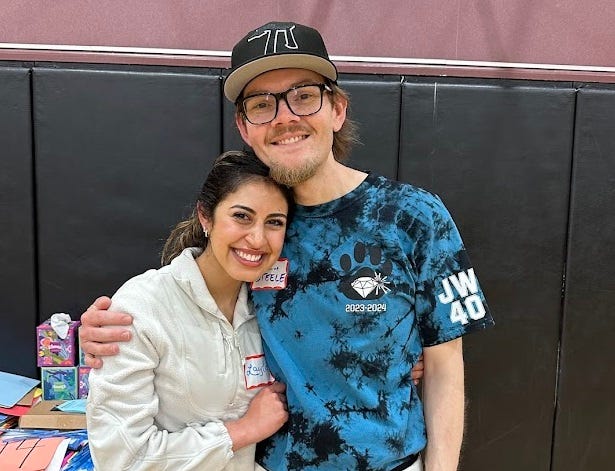

I could absolutely sustain myself writing essays about the people I love and admire until the week I die. Writing and revising this one absolutely made me feel better. Score another point for Layla.
Unlike the piece I wrote about Tyler in October, Layla actually receives this newsletter; she was the second subscriber, in fact. Of course, I hope she reads it, but if she doesn’t, that’s okay because she already knows how much I look up to her.

This is the word I wanted.
A story for another day. Perhaps this summer?
You wrote about Layla so beautifully, Michael. I am always intrigued by how writers write about others — what they see in them, how they make their essence come alive on the page. This essay was a wonderful example of that.
You also made me think about some of the teachers who taught me in high school. It’s a terribly ignorant and naive thing to have done but at that age I never considered how my behaviour impacted them, they were just the teacher and I was the wayward student. But reading about how Layla lifted you up with her rapt focus and attention helped me see my teachers, and even the teacher-student dynamic in a different light. :)
This is such a gift on this Sunday morning. You say Layla is one of your role models and that you try to emulate her way of being, and that is clear to anyone who observes you on a daily basis. Just know that you are other people’s Layla! The number of current and former students who appreciate your time, dedication and thoughtfulness is beyond calculation. Just as Layla has given you hope when the world feels dark, you too have been the dawn for others who felt lost. The fact that you choose to seek happy memories when everything else feels suffocatingly dreary is both inspirational and the greatest honor you can pay those people you call role models, like Layla. Just like Layla who always chose to give her all everyday, you chose to push through darkness to look for light—and you will always find it when you seek it. Hope this week is better than last!